Instant Funding for Stocks: How Instant Stock Accounts Work
How an instant funded stock account works: real US stocks with simulated fills, six tiers, a static drawdown, the 3:58 PM close and the payout rules.
 Mehul Patel
Instant funding for stocks means you buy a simulated equities account and start trading it the same day, with no evaluation to pass first. At The TradeMakers that product is Instant Equities. You trade real US stocks on live market data with simulated fills, under fixed daily and total loss limits.
I run The TradeMakers, a futures and equities prop firm, so read this as the operator's walk-through of one instant stock account: what you can trade, what it costs per share, when you have to be flat, how payouts work and where traders lose the account in week one. If you are still deciding between an instant account and an evaluation, start with our full guide to instant funding vs evaluation. This post goes deeper on stocks only.
Key facts (TradeMakers Knowledge Base, checked October 25, 2026)
- Instant Equities skips the evaluation. Qualified traders pay a one-time fee and trade a simulated account from day one. Overview of the Instant Equities Program
- Six tiers, from a $10,000 simulated account (Express) to a $350,000 simulated account (Ultimate).
- Every tier uses a static max drawdown: a fixed floor that never moves up with profits. Account Rules and Drawdown Type
- Positions must be reduced or fully closed by 3:58 PM ET, and there is no auto-liquidation.
- Execution fee: $5 per 1,000 shares, $1 minimum ticket each way.
- Before a payout, your balance has to reach a minimum balance for withdrawal, shown as the Buffer Zone on the tier table. Instant Equities Payouts
TL;DR: An instant funded stock account lets you day trade liquid US stocks on a simulated account right away, with a static floor instead of a trailing one. Treat it as a day-trading account, size every trade to your max drawdown, and build the buffer before you think about a payout.
Can you get instant funding for stocks?
Yes, but it is less common than you would think. Instant funding is common in forex and futures. On the stock side, most stock prop firms I have looked at either make you pass a challenge first or have you trade stock CFDs, which are contracts that track a share price rather than the stock itself.
When you check any firm that says it offers instant funding for stocks, ask three questions before you pay:
- What do you actually trade: real stocks on live market data, or CFDs?
- Is the drawdown static or trailing, and does it count open profit?
- What has to happen before your first payout, written down on a page you can link to?
If a firm cannot answer all three in writing, keep your money.
Real stocks or CFDs: what you trade on Instant Equities
On Instant Equities you trade real US stocks on live market data, with simulated fills. You do not own the shares and you are not trading the firm's money. The account is simulated. What is real is the tape you are reading: the same quotes and prints every other stock trader sees.
That matters more than it sounds. A stock trader's whole read is price, volume and the level. If the instrument you trade is a CFD priced by someone else, your levels and your fills can drift from the stock you are watching. Live market data keeps your chart and your account looking at the same thing.
Execution runs on the BlackArrow platform.
What stocks you can trade
We focus on highly liquid names, because that is what our traders trade. Low-float and low-volume stocks are not on the platform, so you cannot trade them. As a rough guide, a stock typically needs to trade above $5 and do about a million shares a day.
Shorting works the same way, with one catch: short inventory is not unlimited. A stock you can buy may not always be available to short. If you are new to how shorting works, the SEC's investor site has a plain explanation of short sales.
Be honest with yourself here. If your strategy is chasing low-float runners at the open, this is not the account for that. If you trade liquid large caps and the names that move on real volume, it fits.
How an Instant Equities account works, start to finish
From our Knowledge Base:
The Instant Funding Model allows qualified traders to begin trading immediately on a live simulated account, without completing an evaluation challenge.
The steps, in order:
- Choose a tier, Express to Ultimate.
- Pay the one-time fee.
- Get your simulated account with preset limits.
- Trade under the TradeMakers rules.
- Qualify for payouts after meeting the minimum trading-day and profit requirements.
All tiers allow up to 5 accounts in total per trader. Read the limits for the tier you are buying before your first trade, not after.
The six tiers, read as risk
Here are the daily loss limit and static max drawdown for each tier, straight from the Instant Equities rules page:
- Express, $10,000 simulated: daily loss limit $400, max drawdown $500
- Premium, $25,000 simulated: daily loss limit $750, max drawdown $1,000
- Elite, $50,000 simulated: daily loss limit $1,500, max drawdown $2,000
- Gold, $100,000 simulated: daily loss limit $3,000, max drawdown $4,000
- Platinum, $200,000 simulated: daily loss limit $4,500, max drawdown $7,500
- Ultimate, $350,000 simulated: daily loss limit $10,000, max drawdown $14,000
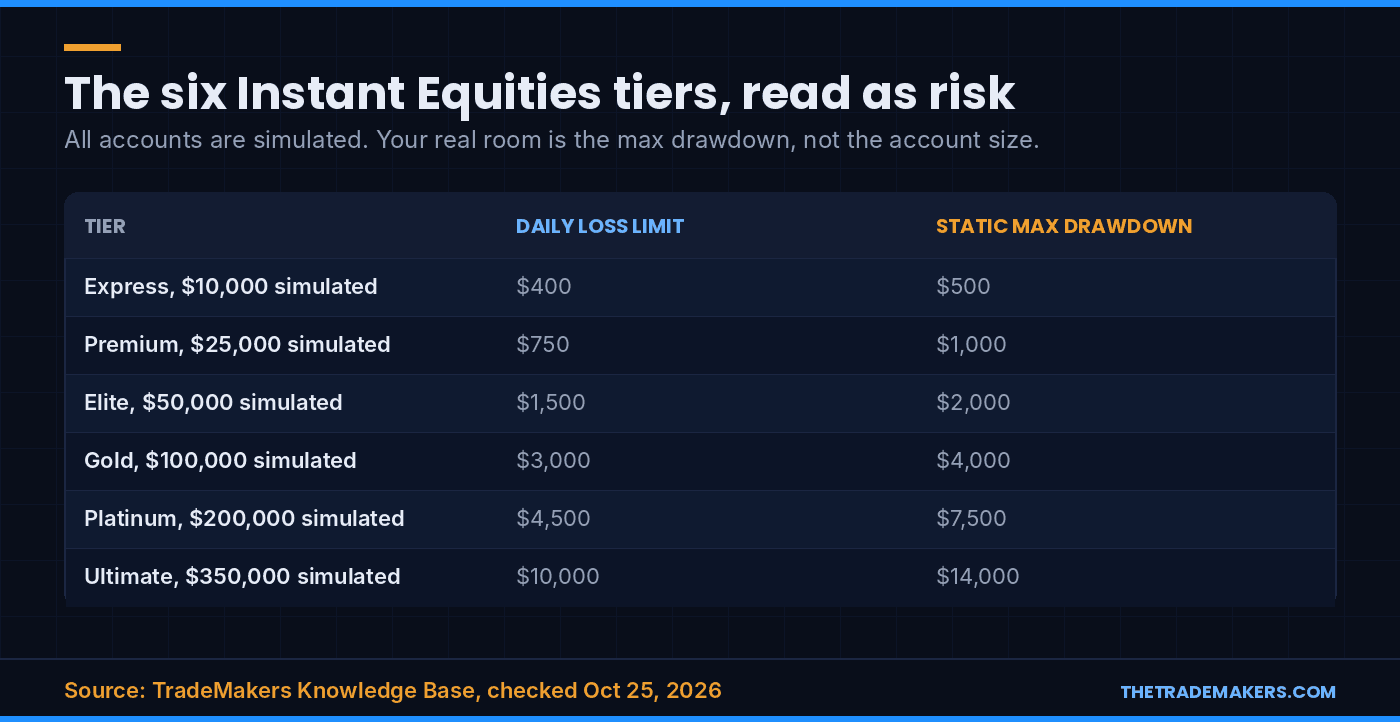
Most people read that list top to bottom by account size. Read it by the last column instead. The max drawdown is your real room. On Gold you have $4,000 of room for the life of the account, not $100,000.
Example only. Say you trade Gold and risk $200 per trade. That is 20 full losses before the max drawdown and 15 before the daily loss limit on a single day. With a $0.50 stop, $200 of risk is 400 shares. With a $2.50 stop on a higher-priced name, it is 80 shares. Same risk, very different share count. Size from the stop and the dollar risk, never from the account size.
The two limits work differently. The daily loss limit is a soft breach:
Breaching this limit does not immediately close the account. It is a soft breach; the account reopens the next trading day.
It still counts when you ask for a payout, though. The payouts page requires no breaches of drawdown, daily loss, or platform rules.
The max drawdown is not a soft breach:
If equity ever drops below the Max Drawdown threshold, the account is permanently closed.
Static drawdown on a stock account
Every Instant Equities tier uses a static drawdown. Our Knowledge Base defines it as a fixed maximum loss limit that never changes after account activation, with this example:
If you have a $100,000 account with a $4,000 static drawdown, your minimum allowable equity is $96,000. Even if your account grows to $120,000, your minimum threshold remains $96,000.
On stocks this matters every single day. Stocks chop. A good short can bounce a dollar against you before it breaks. With a static floor, that bounce costs you nothing in room, because the floor never moved up while you were in profit. You can plan entry, stop and target the way you would at a broker and let the trade work.
I lay out the full math on static versus trailing drawdown, including why trailing floors push traders into quick 1 to 1 exits, in the instant funding vs evaluation guide. I will not repeat it here.
What it costs to trade: the per-share fee
The execution fee is $5 per 1,000 shares, with a $1 minimum ticket each way. It sounds small. For an active trader it is not.
Example only. Buy 500 shares and sell 500 shares: $2.50 each way, $5 round trip. Do that 20 times in a day and you have spent $100 before your first winner counts. Trade 200 shares instead and each side hits the $1 minimum, so a round trip is $2.
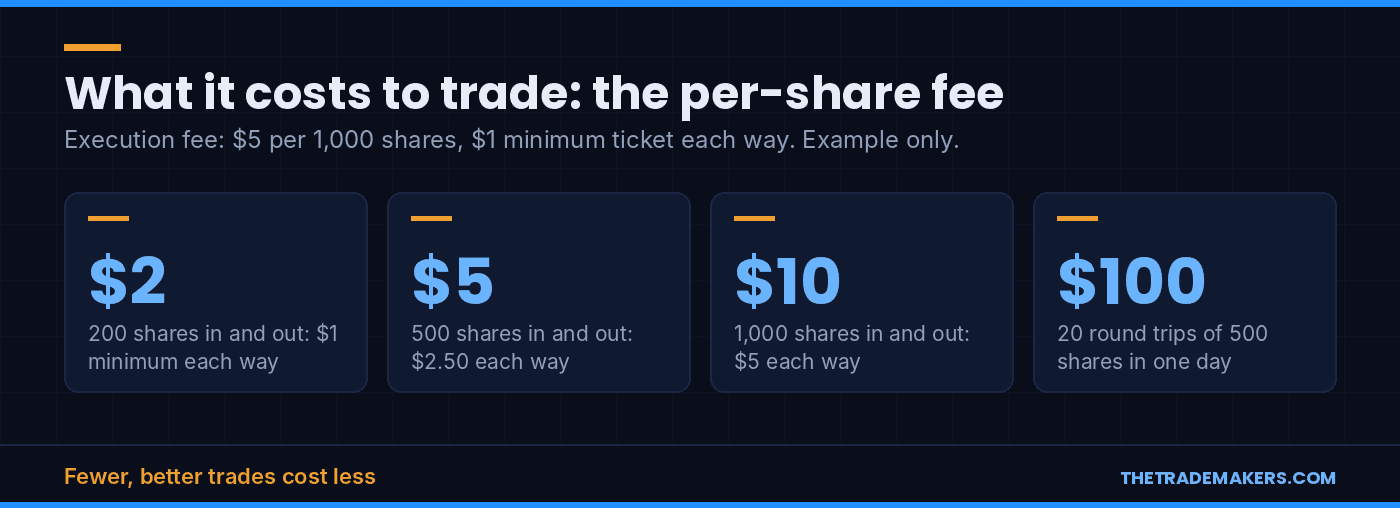
Two things follow. First, if you scalp for a few cents, the fee can eat the edge, so count it in your plan. Second, size and frequency both cost money. Fewer, better trades are cheaper.
The trading day: be flat by 3:58 PM
Treat Instant Equities as a day-trading account. The rules page says:
Positions must be reduced or fully closed by 3:58 PM EST.
and
There is no auto-liquidation; the trader is responsible for reducing position size.
That second line is the one that catches people. Nobody flattens you at 3:58. If you are still holding size into the close, that is on you. Set an alarm for 3:50 and start working out of positions then, not at 3:57 when the closing auction is about to hit. Regular NYSE hours and the closing times are on the NYSE hours and calendars page.
Plan your day around being flat before the bell. That keeps you out of overnight gaps, where a stock can open far past your stop and there is nothing your stop can do about it. The SEC's investor site explains why prices can move sharply in after-hours trading.
Earnings, news and hedging rules for stocks
Earnings are the biggest stock-specific risk, and the rules are clear. From our News and Earnings Trading page:
Do not open or hold positions during the earnings release window for the company being reported.
Avoid correlated exposure (e.g., trading SPY or QQQ during Apple or Microsoft earnings).
The page gives a timed example: if Apple reports at 4:05 PM ET, do not open or hold AAPL, SPY or QQQ trades between 3:55 PM and 4:15 PM ET.
Hedging is not allowed. That includes direct hedges and cross-instrument hedges, like being long one stock while short a correlated ETF against it. The full list is on the Hedging Policy. Pick a side and manage it with a stop.
A real trade: why room to breathe matters on stocks
I trade index futures most days, so on stocks I am selective. I wait for the setup I want and pass on the rest.
On Friday, October 16, 2026, META gave me one. The stock sold off hard from the open, then built a bear flag under 718. I shorted the break of the flag at 718 with a stop $2.50 above. Before it broke, it chopped sideways inside the flag, the kind of back and forth that tests your patience and your floor. I scaled out on the way down and covered the last piece at 709, when price got very extended from the 9 and 20 EMAs on the 5-minute chart.
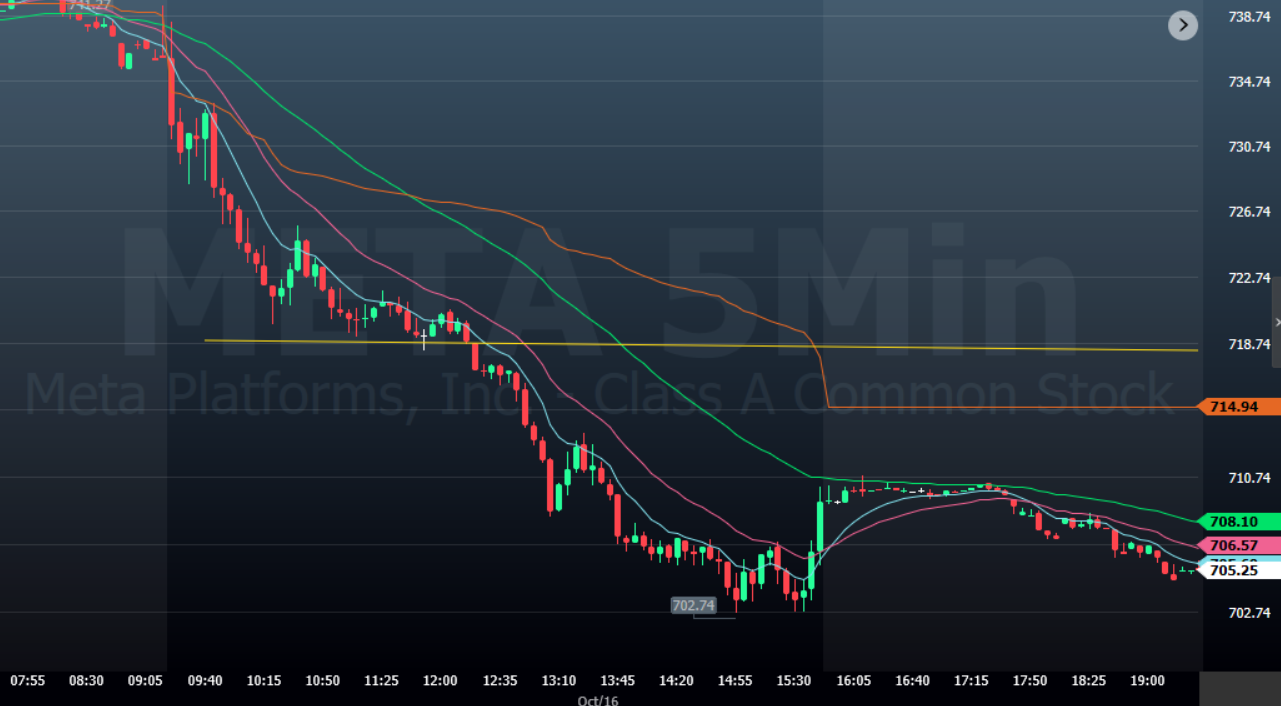
That last piece was about 9 points of move against $2.50 of risk, roughly 3.6 to 1. This trade was not on a TradeMakers account. I show it because the structure is the point: a 3.6 to 1 short on a stock that chops first needs a floor that stays put while you wait. A static drawdown gives you that.
The day-one mistake: sizing to buying power
The biggest mistake I see on instant stock accounts happens in the first hour. Someone buys a large tier, gets the login and starts trading with all their buying power.
Look at Ultimate: a $350,000 simulated account with a $10,000 daily loss limit and a $14,000 static max drawdown.
Example only. Risk 1% of the account size per trade and that is $3,500 a trade. Three full losses is $10,500, past the daily loss limit. Four full losses is $14,000, and with fees that takes you through the entire max drawdown. Four bad trades and the account is closed for good.
Size to your max drawdown, not to your buying power. Buying power is there for the rare setup with a very tight stop and limited risk. It is not a target.
Use week one to set up. Build your layouts in BlackArrow, set your hotkeys, test every order type, and write your risk per trade down as a slice of your max drawdown. Then trade.
Payouts on Instant Equities: build the buffer first
Before your first payout, your simulated balance has to reach the minimum balance for withdrawal. On the tier table it is called the Buffer Zone. From the Instant Equities Payouts page:
- $10,000 account: $10,500
- $25,000 account: $26,500
- $50,000 account: $52,500
- $100,000 account: $104,500
- $200,000 account: $207,500
- $350,000 account: $365,500
Example only. On the $100,000 simulated Gold account, the first $4,500 of simulated profit builds the buffer before any payout is possible.
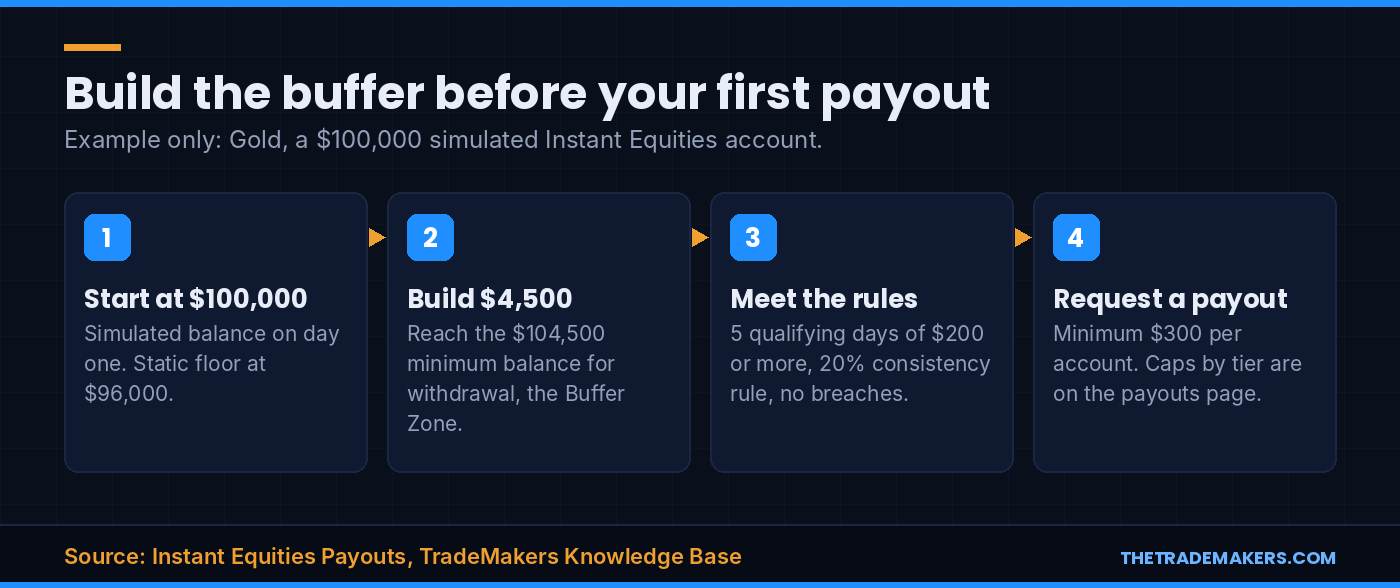
The eligibility rules on the same page:
- Consistency rule: 20% rule: no single day may account for more than 20% of total profits.
- Minimum trading days: trade at least 5 qualifying days since activation or last payout.
- Daily profit minimum: each qualifying day must earn at least $200 in realized profit.
- Payout interval: minimum 5 active trading days between each payout request.
- Compliance review: no breaches of drawdown, daily loss, or platform rules.
The minimum payout is $300 per account per withdrawal. Each payout request is also capped by tier, with higher caps after your 4th payout; the caps are listed on the same page.
Read the consistency rule twice. One huge day does not carry you to a payout. Steady days do. If you want the bigger picture on why instant accounts carry payout conditions like these, and how they differ from a profit target, it is covered in the instant funding vs evaluation guide.
Who an instant stock account fits
Instant Equities fits a trader who:
- Day trades liquid US stocks and is flat by the close.
- Already has a plan and a risk process and wants to start without an evaluation.
- Can size every trade as a small slice of a fixed max drawdown.
It does not fit a trader who:
- Chases low-float runners.
- Holds swing trades overnight.
- Scalps a few cents hundreds of times a day without counting the per-share fee.
If that second list is you, an evaluation or a different product may suit you better. The instant funding vs evaluation guide walks through who should pick which.
If Instant Equities fits how you trade, the tiers are in our pricing section. Read the Instant Equities overview for your tier before you buy.
About the Author
Mehul Patel is the CEO of The TradeMakers and a futures trader. He holds a dual degree in aerospace and mechanical engineering and worked at Goldman Sachs in operations and program management, where he built a forex prediction program from historical market data. He trades index futures and has passed evaluations at several futures prop firms, adding up to more than $4.5 million in simulated funded accounts. He is also a co-founder of Prodisphere, a sports technology company. Every rule for TradeMakers futures and equities accounts is published in the TradeMakers Knowledge Base.
Connect with Mehul: LinkedIn | X | Instagram
Frequently asked questions
Can you get instant funding for stocks?
Yes. Instant Equities at The TradeMakers is a simulated equities account you can trade right after purchase, with no evaluation first. Many stock prop programs still require a challenge or trade CFDs, so check what a firm actually offers before you buy.
Is an instant funded stock account real money?
No. The account is simulated. You trade real US stocks on live market data with simulated fills, but you do not own shares and you are not trading the firm's money.
Do you trade real shares or CFDs on Instant Equities?
You trade real US stocks on live market data, with simulated fills. It is not a CFD account.
What drawdown does an instant stock account use?
Every Instant Equities tier uses a static max drawdown: a fixed floor set at activation that never moves up with profits. If equity drops below it, the account is permanently closed.
Can you short stocks on an instant funded account?
Yes, on liquid names. Short inventory is not unlimited, so a stock you can buy may not always be available to short.
Which stocks can you trade?
Highly liquid US stocks. Low-float and low-volume names are not on the platform. As a rough guide, a stock typically needs to trade above $5 and do about a million shares a day.
Should you hold stocks overnight?
Plan not to. Treat Instant Equities as a day-trading account. The rules say positions must be reduced or fully closed by 3:58 PM EST, and there is no auto-liquidation, so be flat before the close.
Can you trade stocks around earnings?
Not during the release window. Do not open or hold the reporting stock during its earnings window, and avoid correlated exposure like SPY or QQQ during a mega-cap report.
What happens if you hit the daily loss limit?
It is a soft breach. The account does not close; it reopens the next trading day. It still counts in the payout review, which requires no breaches of drawdown, daily loss, or platform rules.
How much should you risk per trade?
Size each trade as a small slice of your max drawdown, never your buying power. On the $350,000 simulated tier, risking 1% of the account size per trade means four full losses wipe out the max drawdown.
What does it cost per trade?
The execution fee is $5 per 1,000 shares, with a $1 minimum ticket each way.
What is the Buffer Zone?
It is the minimum balance for withdrawal: the balance your simulated account must reach before a payout. On the $100,000 simulated account it is $104,500.