Instant Funding vs Evaluation: The Complete Prop Firm Guide
A prop firm CEO who sells both explains instant funding vs evaluation: what you skip, what gets stricter, and how to pick the right account for stocks or futures.
 Mehul Patel
Instant funding vs evaluation comes down to one choice: start trading a simulated funded account on day one, or pass a timed challenge first. Instant funding skips the test and costs more upfront. An evaluation costs less to start and makes you prove yourself first.
I am the CEO of The TradeMakers, and we sell both. That gives me a view most of the articles on this topic do not have, because most of them are written to sell one model. This guide covers what each account really is, the advantages of instant funding, the honest tradeoffs, the payout rules that trip traders up, and how to pick the right account for the way you trade.
Key facts (TradeMakers Knowledge Base, checked October 18, 2026)
- An instant funded account lets you trade a simulated account right after purchase, with no evaluation challenge. Overview of the Instant Equities Program
- An evaluation account requires you to hit a profit target under loss limits before you get a funded simulated account. On our Challenge Equities program the target is 6% of the starting balance within 30 days. Challenge Equities rules
- Instant Equities uses a static max drawdown that never moves up with profits. The Challenge Equities evaluation uses an intraday trailing drawdown that counts open profit. Drawdown Types
- Instant accounts are stricter on payouts in one place: our Instant Equities consistency rule is 20%, against 40% on Challenge Equities. Choose Your Account
- Every TradeMakers account is simulated. You never trade the firm's money.
TL;DR: Instant funding removes the profit target, the clock and the trailing drawdown that pushes traders into quick 1 to 1 exits, so you can trade from day one the way you would trade your own account. You pay more upfront and face a tighter consistency rule on payouts. Evaluations are a smart, cheap way in for newer traders who treat them as practice with real stakes, and a trap for anyone who treats a discounted fee like a lottery ticket.
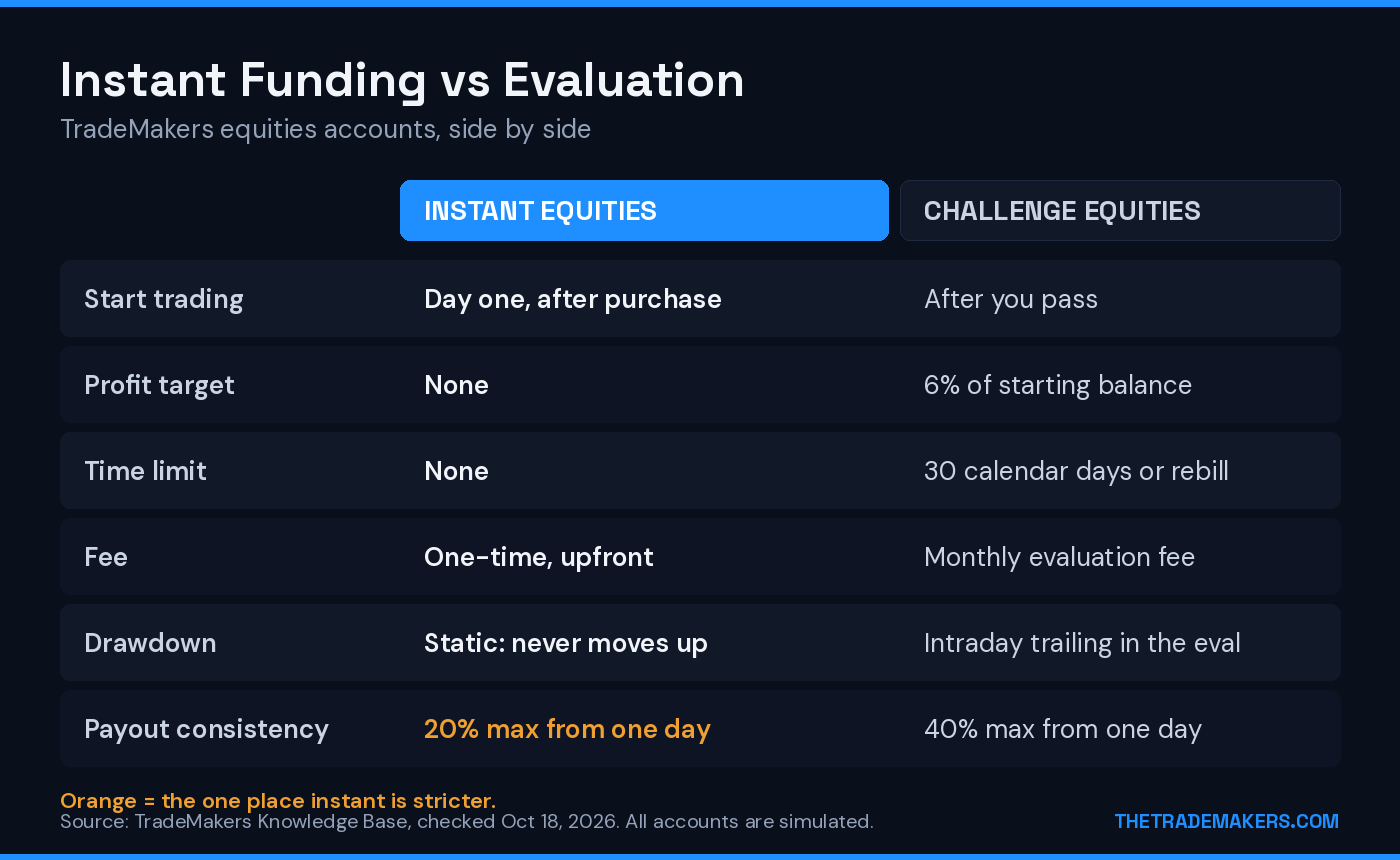
The one place instant is stricter is the payout consistency rule.
What is inside this guide
- What an instant funded account is
- What an evaluation account is
- Instant funding vs evaluation side by side
- The real advantages of instant funding
- How evaluation rules shape your habits
- Static vs trailing drawdown, with the math
- The tradeoffs nobody likes to print
- Payout conditions vs profit targets
- The two reasons payouts get denied
- Instant funding for stocks
- Instant funding for futures
- How to size an instant account
- Who should choose instant and who should choose an evaluation
- How to check any instant funding firm before you buy
- Where to start
- FAQ
What an instant funded account is
An instant funded account is a simulated trading account you can trade the day you buy it. There is no challenge to pass and no profit target to hit before you are funded. You pay a one-time fee, get fixed risk limits, and trade under the firm's rules from the first session.
Our Knowledge Base puts it this way:
The Instant Funding Model allows qualified traders to begin trading immediately on a live simulated account, without completing an evaluation challenge.
Two words in that sentence matter more than the rest. Immediately means no waiting period. Simulated means exactly what it says. Prop firm accounts like ours are simulated accounts that run on market data. Your results there decide your payout eligibility, but you are not trading the firm's capital. Any firm that blurs that line deserves a hard look, and I come back to it in the section on checking a firm.
On The TradeMakers, instant funding exists for both stocks (Instant Equities) and futures (Instant Futures). Most firms that sell instant accounts only offer futures, forex or CFDs.
What an evaluation account is
An evaluation account, also called a challenge, is a test. You pay a fee, usually monthly, and trade a simulated account under a set of rules. Hit the profit target without breaking a loss limit inside the time window and you get a funded simulated account. Break a rule and you start over.
Our Challenge Equities program is a standard example. From the rules page:
- Reach 6% of your starting balance within 30 days.
- Do not lose more than 2% of the starting balance in one trading day.
- Total drawdown cannot exceed 4% from the starting balance.
- Trade at least 5 separate days.
- Your largest profitable day cannot exceed 40% of total profits.
- Complete the challenge within 30 calendar days or be rebilled.
Pass, pay a one-time activation fee, and you move to a funded simulated account. The full table is on the Overview of Challenge Equities.
Evaluations are not a scam and they are not a waste. They are a filter. The question is whether the filter measures the trading you actually want to do.
Instant funding vs evaluation side by side
Here is how our two equities products line up, straight from the Knowledge Base:
- Start trading. Instant: day one, after purchase. Evaluation: after you pass.
- Profit target. Instant: none. Evaluation: 6% of the starting balance.
- Time limit. Instant: none. Evaluation: 30 calendar days, or you are rebilled.
- Fee. Instant: one-time upfront fee. Evaluation: monthly evaluation fee, plus an activation fee after passing.
- Drawdown. Instant: static, fixed at activation. Evaluation: intraday trailing during the challenge, end-of-day trailing once funded.
- Payout consistency. Instant: no single day may account for more than 20% of total profits. Evaluation funded accounts: 40%.
Most of that list favors instant. The last line does not, and I would rather tell you now than have you find it at payout time.
The real advantages of instant funding
You start trading today. No profit target and no clock. You can build from day one instead of spending a month proving something to a scoreboard.
You trade your plan, not the test. A profit target with a deadline changes how people trade. They press when they are behind and freeze when they are close. Without a target, the only job is to trade well and respect the risk limits.
No monthly rebill. One fee, not a subscription that renews every time the calendar runs out.
A drawdown that does not chase you. On Instant Equities the max drawdown is static. It sits at a fixed dollar level and stays there, so a winning trade that pulls back does not shrink your room. More on this below, because it is the most underrated difference between the two models.
You manage a real max loss from the first trade. This is the biggest one, and it is about habits, not convenience.
How evaluation rules shape your habits
The common argument for evaluations is that they build discipline. Sometimes they do. Often they do the opposite, for two reasons.
Reason one: a cheap fee feels like the only risk. Evaluations are routinely sold at deep discounts across the industry, sometimes up to 90% off through influencer codes. When an account costs $40 or $50, the fee starts to feel like the risk. Traders think, I only lose 50 bucks, so why not go all in? We hear from traders who burn through dozens of evaluation accounts in a single month that way. Every one of those accounts trains the same habit: size up, swing for the fences, buy another one. That is the opposite of how you would trade your own account, where your max loss is real and you protect it.
That applies to any cheap evaluation, ours included. We sell evaluations too, and they are a good product for the right trader. The trap is the mindset, not the account.
Reason two: trailing drawdowns train quick exits. Most evaluations use an intraday trailing drawdown that counts open profit. When your trade works, your floor moves up with it. When the trade pulls back, as almost every winner does, that pullback eats your room even though you are still in profit. So traders learn to sell into the first pullback to protect the cushion. Over time that turns almost every trade into a quick 1 to 1 exit. You never learn to hold a winner, because the rules punish you for letting it breathe.
Then you pass, and you have to unlearn all of it.
Static vs trailing drawdown, with the math
Our Knowledge Base defines a static drawdown this way:
A static drawdown is a fixed maximum loss limit that never changes after account activation.
And here is what the Challenge Equities rules page says about the intraday trailing drawdown used in the evaluation phase:
This includes unrealized (open) profits during the trading session.
Example only. Take a $100,000 simulated account with $4,000 of max loss on both a static and an intraday trailing drawdown. Your floor starts at $96,000 on both.
You buy a stock and it runs. You are up $3,000 open. On the trailing account your floor just rose $3,000 to $99,000. On the static account it is still $96,000.
Now the stock pulls back and gives up $2,500 before it rolls higher again. Your equity is $100,500. You are still winning.
- On the trailing account you have $1,500 of room left. One more wiggle and you are out of a winning trade.
- On the static account you have $4,500 of room left. The pullback cost you nothing in room.
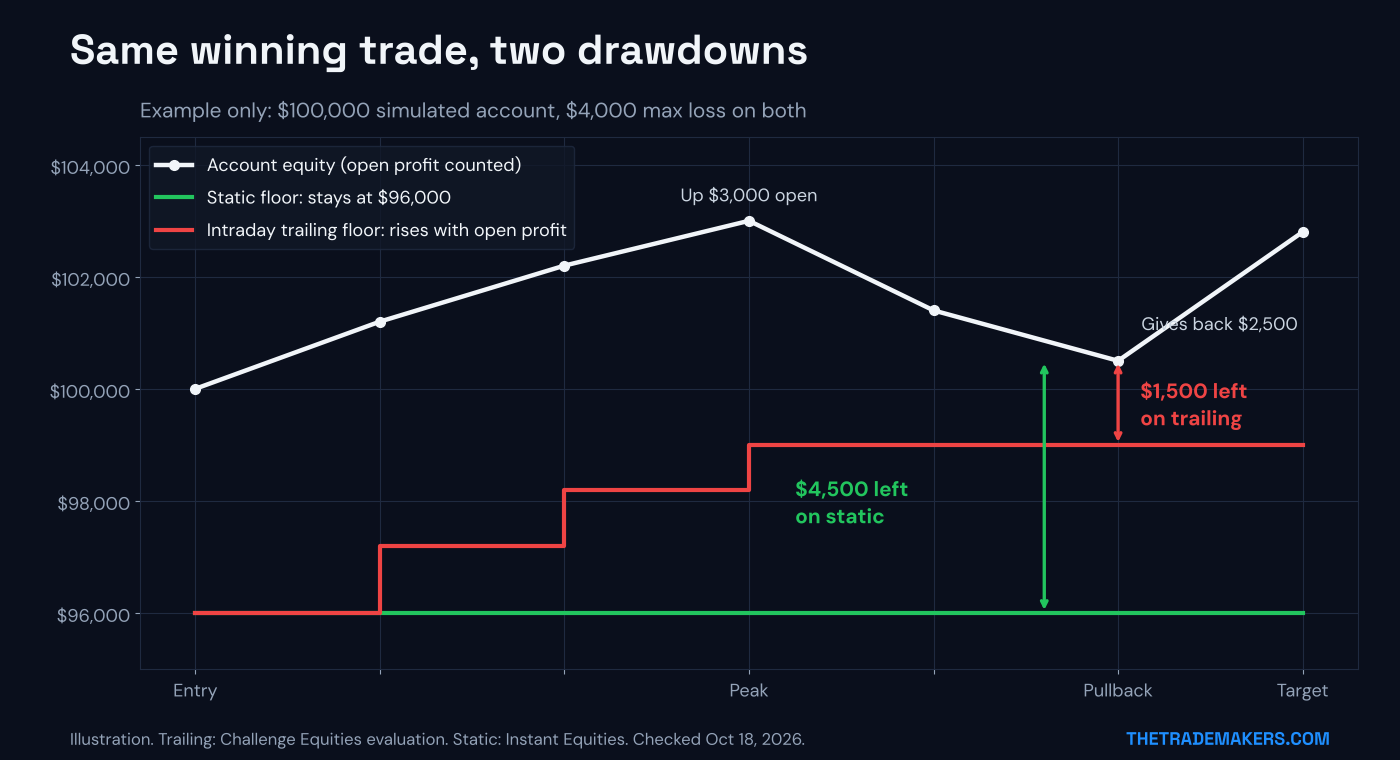
Same trade, same pullback. The trailing floor leaves $1,500 of room; the static floor leaves $4,500.
That gap is why static drawdown was one of the features traders asked us for. It is simpler to manage, and it lets you plan a trade the way you would at a broker: entry, stop, target, and the patience to let it work.
One more definition so you can compare firms properly. End-of-day trailing drawdown, which our futures accounts use, sits in between. Per our Instant Futures rules, it adjusts upward only after the trading day ends and your account closes in profit, and intraday swings do not move it. That gives you room to hold a winner through the session, but your floor still climbs day by day.
The tradeoffs nobody likes to print
Instant funding is not a free pass. Here is what you give up:
- A higher upfront fee. You pay once instead of monthly. Across the industry, an instant account costs more upfront than a month of an evaluation. If you blow the account, the fee is gone.
- A tighter consistency rule. On Instant Equities, no single day may account for more than 20% of total profits for a payout. One huge day will not carry you.
- Qualifying days. Each qualifying day must earn at least $200 in realized profit, and you need at least 5 qualifying days since activation or your last payout. Details on Instant Equities Payouts.
- A hard floor. The daily loss limit on Instant Equities is a soft breach and the account reopens the next trading day. The max drawdown is not soft:
If equity ever drops below the Max Drawdown threshold, the account is permanently closed.
If you cannot pass an evaluation because you cannot control risk, an instant account will not fix that. It will just cost more to find out.
Payout conditions vs profit targets
Some reviewers argue that minimum trading days and profit-per-day rules are a profit target in disguise, and that a real instant account should have none. It is a fair question, so here is the honest answer from the firm side.
A profit target is a gate before you are funded. Miss it and you never get a funded account. Payout conditions are rules for withdrawing profit from an account you already have. You can trade an instant account for as long as you respect the limits, whether you request a payout this month or not.
We have payout conditions for two reasons.
Habits. We want traders who make some money most days, not traders riding a roller coaster of P&L. A consistency rule rewards the trader who builds a track record, one green day at a time.
Risk management for our books. Without a consistency rule, people buy evaluation accounts or even instant accounts and swing for one giant day, hoping to hit and cash out. Example only: someone buys a deeply discounted account and puts full buying power into every trade. Most of the time it goes to nothing. Maybe one time in 20 it hits big. That is a coin flip at the roulette table, and the numbers do not work for any firm that pays out on it. This is a trading business, and we are looking for traders, not gamblers.
So yes, instant accounts have payout conditions. We publish every one of them, and you can read them before you buy.
The two reasons payouts get denied
Breaking the consistency rule. The classic case: a trader goes all in on one trade, gets lucky, and has no real gains on any other day. That one day is more than 20% of total profits, so the payout fails. The fix is the habit above: size so that no single day decides your month.
Hyperscalping and data games. Some traders try to exploit tiny delays between a firm's data and the live market. They buy all in and sell a few seconds later to catch a lag that can be about one second. Our Good Faith Policy lists latency exploitation as a violation, and our Algorithmic Trading Rules prohibit latency arbitrage and feed exploits outright.
Be clear on what is not a problem. A stop that gets hit 20 seconds after entry is risk management. Cutting a bad trade fast is risk management. The red flag is a pattern: when nearly all of an account's profits come from trades held under a minute. The full rules, including how partial exits are treated, are on our Hyperscalping Policy page.
Instant funding for stocks
This is where The TradeMakers is different from most of the industry. Plenty of firms sell instant futures or forex accounts. Instant funding for stocks is rare, and most stock prop programs we have seen run as challenges or as CFDs.
Instant Equities runs on the BlackArrow platform, with six tiers from a $10,000 simulated account (Express) up to a $350,000 simulated account (Ultimate). Every tier uses a static drawdown. A few stock-specific rules to know:
- Positions must be reduced or fully closed by 3:58 PM EST.
- There is no auto-liquidation. Reducing size before the close is on you.
- Stocks reporting earnings after the close or before the open cannot be held overnight.
- You cannot open or hold the reporting stock during its earnings release window, and you should avoid correlated exposure like SPY or QQQ during a mega-cap report. Details on News and Earnings Trading.
- No hedging, including long one stock while short a correlated ETF. See the Hedging Policy.
Stocks also give you something futures do not: thousands of names. That is an advantage only if you are selective. I trade index futures most days, so on stocks I wait for the setup I want and pass on the rest. On a static drawdown, patience is rewarded, because a pullback in an open winner does not shrink your room.
Instant funding for futures
Instant Futures gives you the same no-evaluation start on CME, CBOT, NYMEX and COMEX contracts, with 50k, 100k and 150k simulated account sizes. The Instant Futures overview lists the loss limits, buffers and max position sizes for each, from 5 minis or 50 micros on the 50k up to 15 minis or 150 micros on the 150k.
Two futures rules to know before you buy:
- The drawdown is end-of-day trailing, as described above.
- Overnight positions are not allowed. The futures session runs Sunday 6:00 PM to Friday 5:00 PM EST, with a daily one-hour maintenance break from 5:00 to 6:00 PM EST.
For payouts, Instant Futures uses a 20% consistency rule: no single day may account for more than 20% of total profits. Details on Instant Futures Payouts.
How to size an instant account
The biggest mistake I see on instant funded accounts happens in the first hour. Someone buys a large account, gets the login, and starts ripping trades with all their buying power.
A $350,000 simulated account does not mean you trade $350,000 of exposure. Look at the limits on our Ultimate tier: a $10,000 daily loss limit and a $14,000 static max drawdown.
Example only. Risk 1% of the account size per trade and you are risking $3,500 a trade. Three full losses is $10,500, past your daily loss limit. Four full losses is $14,000, your entire max drawdown. Four bad trades and you are done.
Now risk 5% of your max loss instead: $700 a trade. It takes 20 straight full losses to reach the floor.
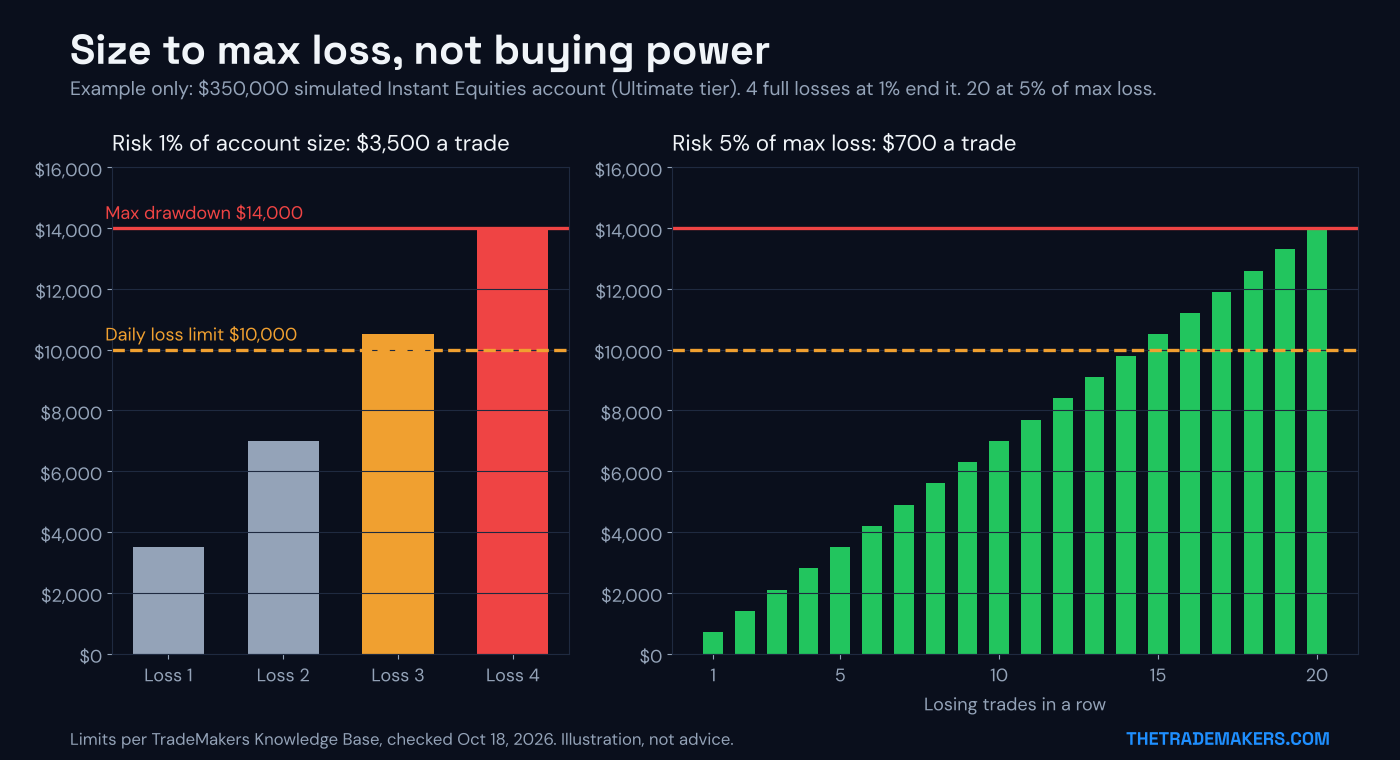
Size to your max loss, not your buying power.
Size to your max loss, not your buying power. Buying power is there for the rare setup with a very tight stop and limited risk. It is not a target. It works the same way at a regular broker: a margin account can give you several times your cash in buying power, but you size to the cash you can afford to lose, because the borrowed part is still yours to repay. FINRA's guide to what triggers a margin call explains how fast that can go wrong. In prop trading, the number you can afford to lose is the max drawdown.
Use your first week to set up properly. Build your layouts, set your hotkeys, test your order types, and write down your risk per trade as a slice of your max loss. Then trade.
Who should choose instant and who should choose an evaluation
Choose instant funding if you already have a written plan and a risk process, you want no profit target and no clock, and you will size to max loss from day one.
Choose an evaluation if you are newer to trading. An evaluation is a great way in when you treat it as a simulator with slightly higher stakes. With zero stakes you can be the best simulator trader in the world and it will not carry over. Even small stakes get you focused and make you feel the emotions of a real trade. Evaluations also make sense if your budget is tight or you want to prove consistency first.
Do not choose either as a lottery ticket. If you are buying discounted accounts to swing for one big day, no account type will fix that.
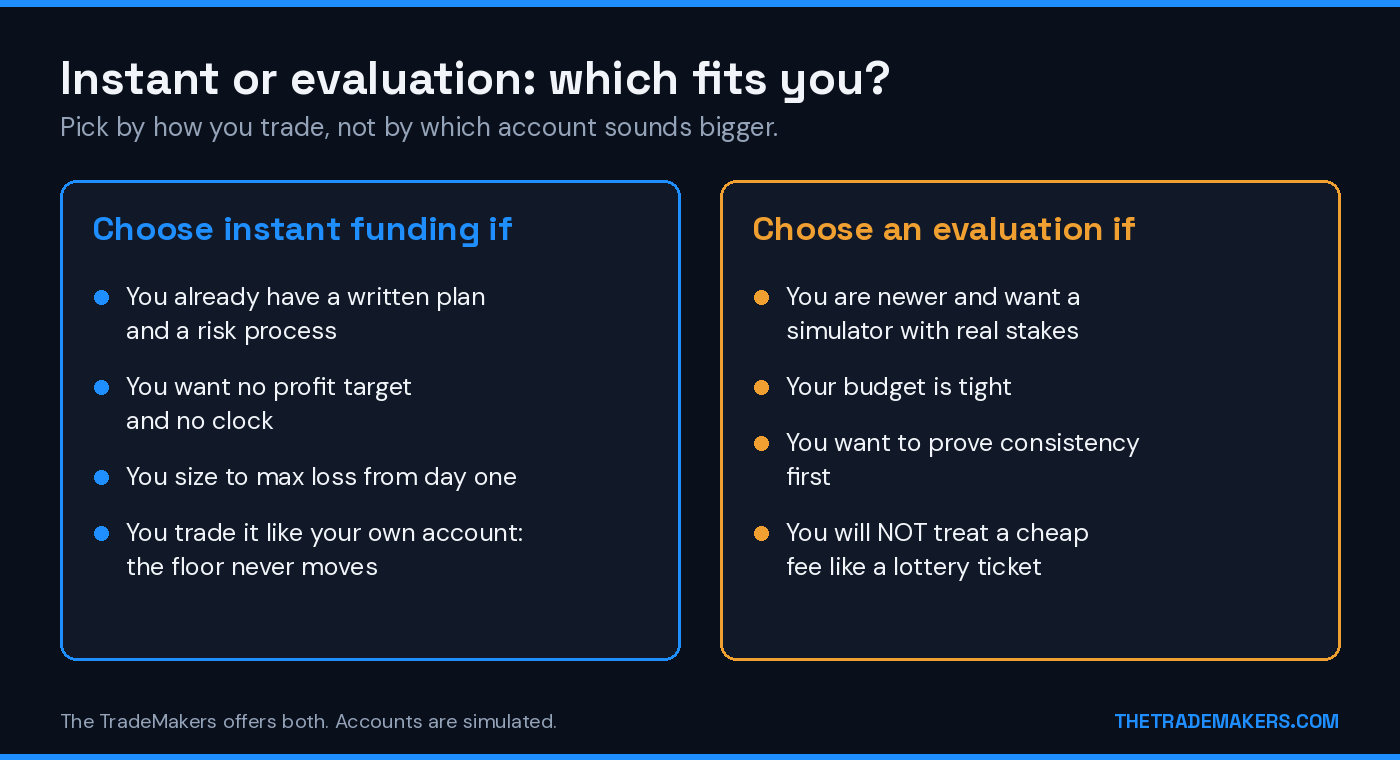
Pick by how you trade, not by which account sounds bigger.
One more option worth knowing about if you trade stocks at a regular broker: FINRA replaced the pattern day trader rule with an intraday margin standard effective June 4, 2026, explained in FINRA's guide to the new standard. Prop accounts and brokerage accounts are different tools. Pick based on how you trade.
How to check any instant funding firm before you buy
Whatever firm you choose, ours or anyone else's, check these before you pay:
- Does the firm say plainly that accounts are simulated? If it implies you trade its real capital, ask hard questions.
- Are the rules published before you buy? Drawdown type, daily loss limit, consistency rule, qualifying days, news rules, and what voids a payout. Our full rulebook is public in the TradeMakers Knowledge Base.
- Is the drawdown static, end-of-day trailing or intraday trailing? The answer changes how you can trade more than any other rule.
- What are the payout conditions? Minimum days, profit per qualifying day, consistency percentage, payout caps and how long processing takes. Ours are on General Payout Details.
- Who gets paid? We only pay out to accounts under the trader's verified name.
- Do not judge a firm by headlines. In 2023 the CFTC sued one prop firm, as its press release shows. In May 2025 a federal judge dismissed that case with prejudice and sanctioned the CFTC for false statements to the court. Charges are not verdicts, so read the firm's published rules for yourself.
Where to start
- Read the account overview for the product you want: Instant Equities or Instant Futures.
- Learn the drawdown on Drawdown Types.
- Read the payout rules for your product before you trade, not after.
- Pick your risk per trade as a slice of max loss and write it down.
- Spend week one on setup, not on size.
- Choose your account on our pricing section.
FAQ: Instant funding vs evaluation
What is the difference between an evaluation and an instant funded account?
An evaluation makes you hit a profit target under loss limits before you get a funded simulated account. An instant funded account gives you the funded simulated account right after purchase, with no challenge first.
Is instant funding worth it?
It is worth it for traders with a tested plan who will size to max loss from day one. It is not worth it for someone who cannot yet control risk, because the upfront fee is higher and the max drawdown is a hard floor.
What is an instant funding prop firm with no evaluation?
It is a prop firm that sells simulated funded accounts you can trade immediately, without a challenge. You still trade under risk limits and payout conditions.
Do instant funded accounts pay out?
Yes, once you meet the payout conditions. On Instant Equities that means at least 5 qualifying days of $200 or more in realized profit, a 20% consistency rule, and no rule breaches.
Is an instant funded account real money?
No. TradeMakers accounts are simulated. You never trade the firm's money.
Why does instant funding cost more?
Across the industry, you pay one larger upfront fee instead of a smaller monthly one, because you skip the evaluation and start on a funded simulated account right away.
Does instant funding have a consistency rule?
On The TradeMakers, yes. Instant Equities uses a 20% consistency rule for payouts, tighter than the 40% on Challenge Equities.
If I cannot pass a challenge, will I lose an instant account?
If you fail challenges because you break risk rules, probably. An instant account does not remove risk limits. It removes the profit target and the clock.
Is static or trailing drawdown better on an instant account?
Static gives you the most room on a winning trade, because the floor never moves. Intraday trailing counts open profit and pushes traders into quick exits. End-of-day trailing sits in between.
Can you get instant funding for stocks?
Yes, though it is rare. The TradeMakers offers Instant Equities, from a $10,000 to a $350,000 simulated account, with a static drawdown.
Can you get instant funding for futures?
Yes. Instant Futures comes in 50k, 100k and 150k simulated sizes with an end-of-day trailing drawdown.
How do I size positions on an instant account?
Size each trade as a small slice of your max drawdown, never your buying power. On a $350,000 simulated account with a $14,000 max drawdown, risking 1% of the account size per trade means four full losses end the account.
How do I tell a real instant account from a renamed challenge?
A renamed challenge still has a profit target you must hit before you are funded. A real instant account funds you at purchase and puts its rules on withdrawals instead. Read the payout conditions before you buy.
Which is better for a new trader?
Usually an evaluation, treated as practice with small real stakes. Move to instant funding once you have a plan you trust and you size to max loss without thinking about it.
About the Author
Mehul Patel is the CEO of The TradeMakers and a futures trader. He holds a dual degree in aerospace and mechanical engineering and worked at Goldman Sachs in operations and program management, where he built a forex prediction program from historical market data. He trades index futures and has passed evaluations at several futures prop firms, adding up to more than $4.5 million in simulated funded accounts. He is also a co-founder of Prodisphere, a sports technology company. Every rule for TradeMakers futures and equities accounts is published in the TradeMakers Knowledge Base.