The TradeMakers
Do Prop Firms Use Real Money? Simulated Accounts Explained
No. Online prop firm accounts are simulated and your trades never reach the market, but an approved payout is real money. Here is how it works and what we check.

Do prop firms use real money? At online prop firms, no. The account is simulated and your trades never reach the market. The real money is your fee going in and an approved payout coming out.
I am Mehul Patel, CEO of The TradeMakers, so I answer this question every week, and the first thing I tell a trader is no, it is not real money. Below is what that means, where payouts come from, what we check before one is approved, and how to read any firm's own terms before you buy. If you are still deciding between account types, start with our guide to instant funding vs evaluation.
Key facts
- At The TradeMakers, unless we state otherwise in writing, every account is simulated and does not involve real financial markets or real capital (Terms of Service, section 4.1, checked November 19, 2026).
- The TradeMakers is not a broker or dealer, a futures commission merchant, a financial advisor, a money manager or an introducing broker (Terms, section 4.2).
- Any payout is a discretionary performance reward, not trading profits (Terms, section 4.3).
- Every payout request goes through a compliance review that typically takes 1 to 2 business days, then payment processing that typically takes 24 to 72 hours, to a payout method in the trader's verified name, such as bank transfer in USD (General Payout Details, last updated May 21, 2026).
- Live-capital accounts through a partner broker are not live today and have no launch date.
TL;DR: Online prop firm accounts are simulated. Prices are based on live market data, but your orders never go to the market. Follow the rules, pass the payout review, and an approved payout is real money sent to you. What you put at risk is the account fee plus any listed fees, such as execution fees.
Two kinds of prop firm
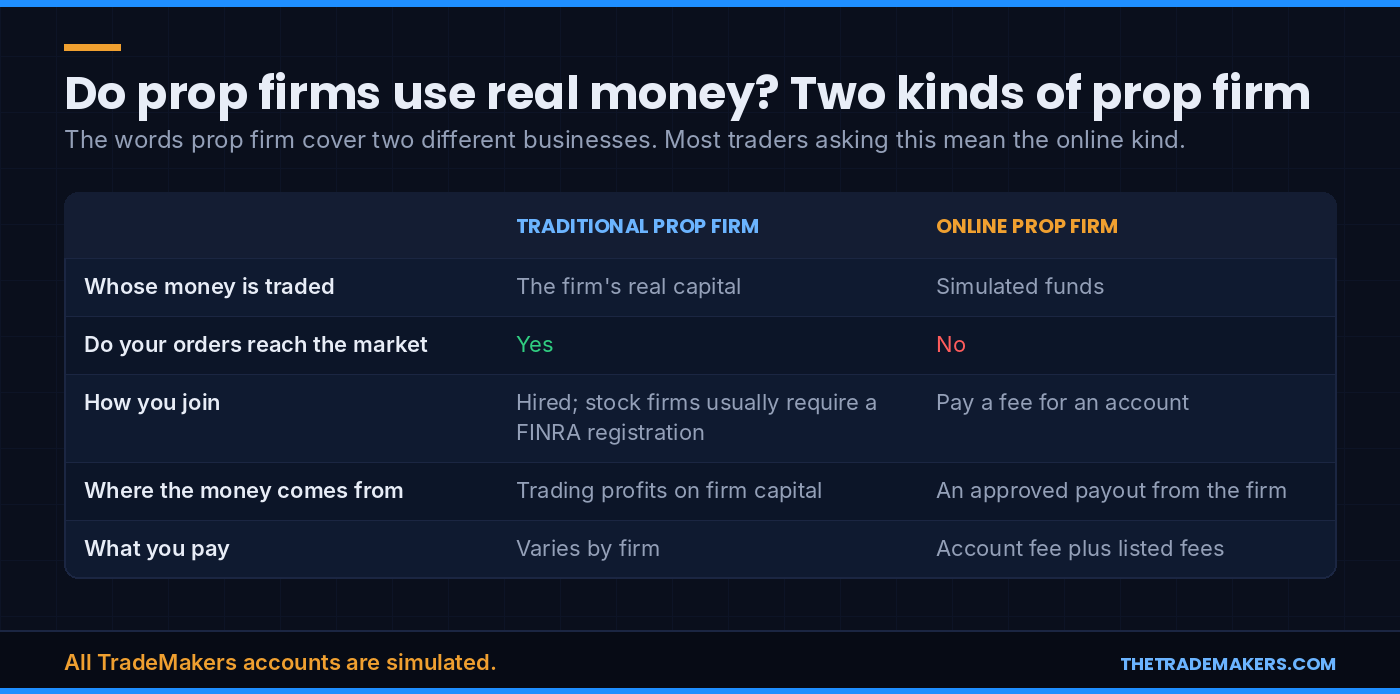
The words prop firm cover two very different businesses, and most of the confusion starts right there.
Traditional prop firms put you on a trading floor with dozens of other traders. You trade real capital from a pool the firm gives you. You are close to a Wall Street floor trader. Stock prop firms that are FINRA members usually require their traders to register, today through the Series 57 securities trader exam, and some pay a small salary. That is a job at a trading firm.
Online prop firms are a totally different game. You pay a fee, you trade a simulated account under published rules, and you request a payout when you meet them. At The TradeMakers, your trades do not go to the market. Period.
The closest picture I have is a flight simulator. The controls are real and the instrument readings are real, but there is no plane in the air.
What a simulated prop account is
Our terms define it plainly:
Simulated Account: a demo environment using simulated funds that does not involve trading real capital.
The funded stage is simulated too. Our terms define a funded account as a simulated account where payout eligibility is based on performance. Funded is the industry word for the payout stage. It does not mean real money is sitting behind the account.
On our platform, prices are based on live market data. Your fills are simulated: the platform decides where you got filled from that data. There is no buyer or seller on the other side of your trade.
If the money is simulated, where do payouts come from?
From the firm. No market paid you, because no order of yours ever reached a market. The firm pays an approved payout out of its own business. Our terms say it straight:
Any payout represents a discretionary performance reward, not trading profits.
That is also why we review every payout before we pay it. The money is real, so the review is real.
How do prop firms make money?
From account fees. The way I explain it, prop firms work a lot like an insurance business. Traders pay to open accounts. Some trade well, follow the rules and earn payouts. Others hit their drawdown and the account closes. The firm is playing the math across all of those accounts.
That math is why the rules exist. A drawdown limit, a consistency rule and a payout review keep payouts tied to steady trading, not one lucky day or a gap in the data feed. It is also why you should read the rules as the product. Your fee buys an account under those rules, nothing more.
What we check before a payout is approved
The first thing we check is whether the trader followed the rules. Did they meet the consistency rule, the profit target and the other payout conditions for their account? Each product has its own payout page in our Knowledge Base.
Then we look at how the profit was made. Two things get the most attention.
Hyperscalping. Our Hyperscalping Policy says a trade opened and closed within 60 seconds may be flagged. One quick trade is not a violation, and a stop loss that hits right after entry is normal risk management. What we review is whether the account's profit comes mainly from those very short trades.
Latency exploitation. A data feed can trail the live market by a split second. Some clever traders try to trade that gap. Example only: they watch a faster feed, see the real market already 10 ticks higher, buy on the simulated feed and sell one second later, again and again. On stocks the same idea shows up as playing the spread. Our Good Faith Policy lists latency exploitation with the consequence account termination, and the General Payout Details page lists latency or data exploitation as payout forfeiture and ban.
The same payout page also lists what else voids a payout: a drawdown breach, hedging, and automation or bot use.
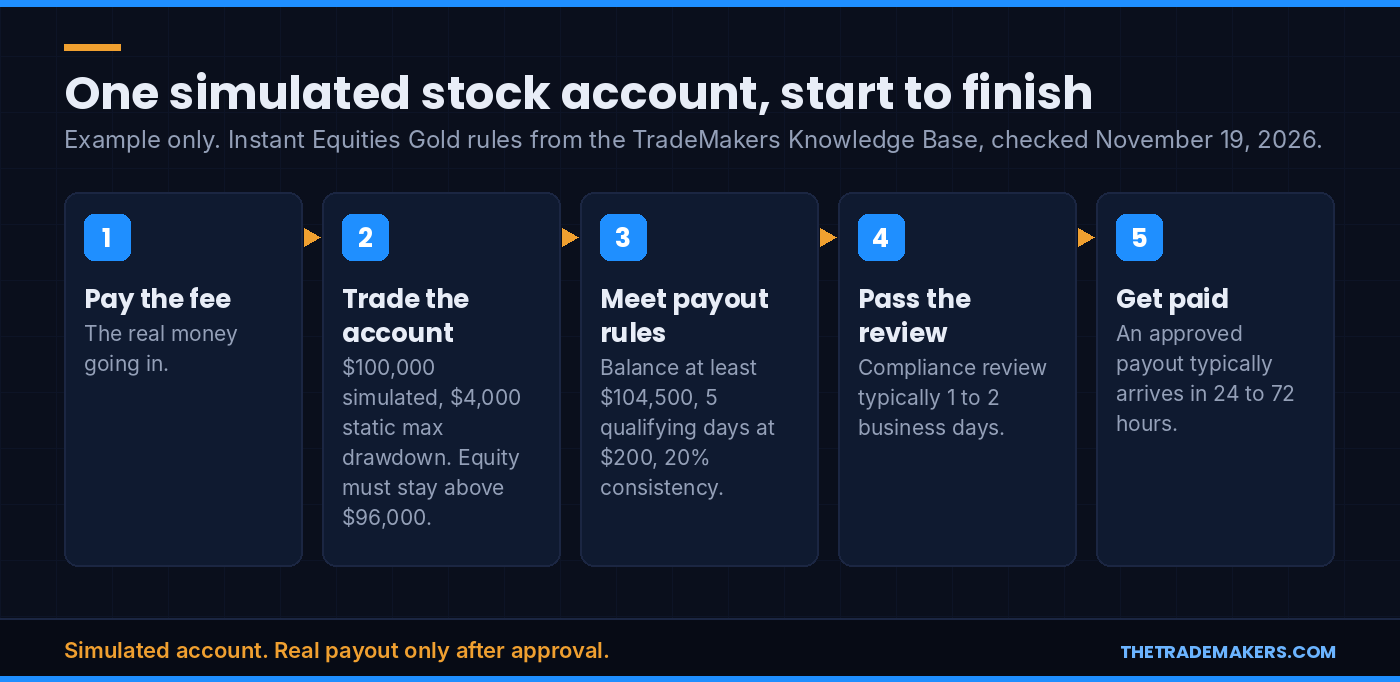
One account, start to finish (example)
Example only, using the published rules for an Instant Equities Gold account (Instant Equities overview), checked November 19, 2026:
- You pay the account fee. That is the real money going in.
- You get a $100,000 simulated account with a $3,000 daily loss limit and a $4,000 static max drawdown. Your equity can never drop below $96,000, or the account is permanently closed (Instant Equities rules).
- You trade listed US stocks priced from live market data, with simulated fills. Positions must be reduced or fully closed by 3:58 PM EST.
- To request a payout, the balance must be at least $104,500. You need at least 5 qualifying days, each with at least $200 in realized profit, and no single day may account for more than 20% of total profits (Instant Equities Payouts, last updated October 5, 2026).
- You submit the request. Compliance review typically takes 1 to 2 business days, then payment processing typically takes 24 to 72 hours.
- If it is approved, real money goes to your payout method in your verified name, such as a bank transfer. Each payout has a maximum set by account size, listed on the same payouts page.
- If it is not approved, or equity drops below $96,000 first, the account fee and any execution fees are gone.
Live prices, simulated fills: what you will notice
Here is where traders feel the difference. At a real broker you can use a midpoint order and get filled between the bid and the ask. On our simulated accounts you will almost always be filled at the bid or the ask.
You can see it for yourself. Pull up the same stock on a separate charting platform with live data, and you will see prints between the bid and the ask from people using midpoint orders. You will never be one of them on our simulated accounts. A simulated feed is just a data feed. There are no actual buys and sells behind your orders, and your trades never print on the tape.
That gap matters more on stock CFDs, where the provider sets its own price. We broke that down in prop firms for stocks.
Do any prop firms put traders on live capital?
Some firms say they move top traders to live accounts or copy their trades into one. If a firm tells you that, read its own terms for the exact wording.
Our terms leave room for it: The TradeMakers may, at its sole discretion, offer live-capital accounts through a partner broker, and such accounts are not guaranteed. That is not live today, and there is no date for it. Today every TradeMakers account is simulated.
What prop firm marketing words actually mean
- Funded account: a simulated account in the payout stage.
- A $100K account, or any account size: the simulated balance. It is not money you control, which is why we call every TradeMakers account simulated.
- Live data or real market conditions: real prices. Your fills are still simulated.
- Profit split: our terms define it as a discretionary payout of simulated profits attributed to a trader.
- Instant funding: immediate access to a simulated account with no evaluation first.
- Live account or live capital: an account where orders reach a market through a broker. Ask which broker, then look it up.
What you can actually lose
The money you pay. On a simulated account none of your own cash is in the trades. What you put in is the account fee plus any fees listed in your account's rules, such as execution fees. Our site footer puts it in four words: fees are not deposits.
Treat every dollar of that as money you can afford to lose. If you cannot, you are not ready for any prop firm.
What happens if a prop firm shuts down?
Read this part of any firm's terms before you buy. Ours are plain about it:
- All fees are final and non-refundable except where legally required (Terms, section 10.1).
- The TradeMakers does not guarantee future payouts or the continued availability of any program (Terms, section 14.3).
- Our maximum liability equals the amount the trader paid (Terms, section 13).
Put simply, a simulated balance is not money you own. Only an approved payout that has reached your bank is. If you qualify for a payout, there is no reason to leave it sitting as a simulated number.
What protections you do and do not have
A simulated prop account is not a brokerage account, so the protections that come with a brokerage account do not apply. SIPC protects customers of its member brokerage firms. Your prop account fee is not a deposit at a broker.
If a firm says your trades go live through a broker, ask which one and look it up yourself. For stock brokers, use FINRA BrokerCheck. For futures firms, use the NFA's BASIC search.
Do not judge a firm by headlines either. In 2023 the CFTC sued one prop firm, and in May 2025 a federal judge dismissed that case and sanctioned the CFTC. We covered it in our instant funding vs evaluation guide. Charges are not verdicts. Read the rules.
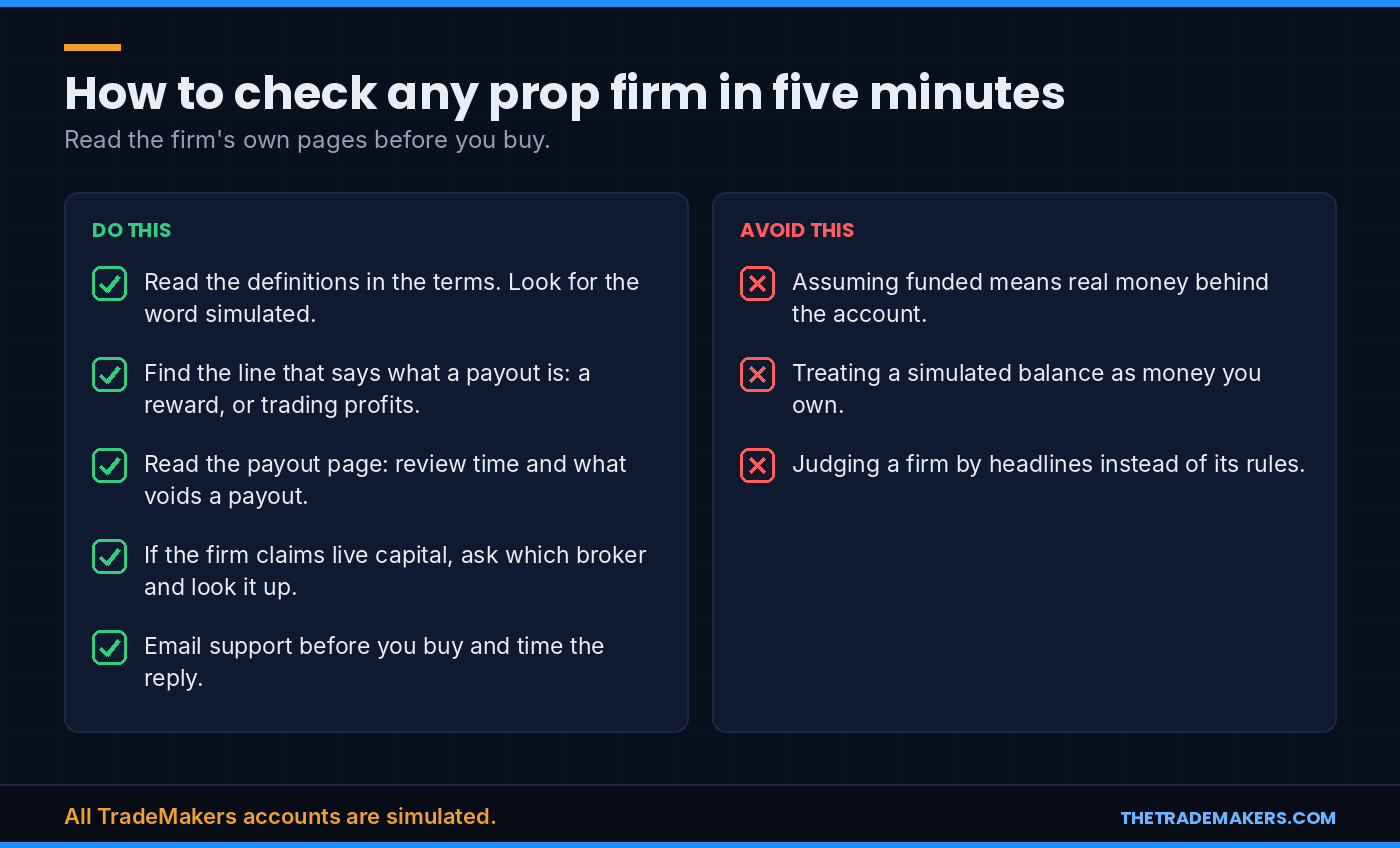
How to check any prop firm in five minutes
- Open the terms and read the definitions section. Look for the word simulated.
- Find the line that says what a payout is: a reward, or trading profits.
- Read the payout page: how long the review takes and what voids a payout.
- If the firm claims live capital, ask which broker and look it up.
- Email support before you buy and time the reply.
Every rule for our futures and equities accounts is published, and you can compare every account on our pricing page. All TradeMakers accounts are simulated.
About the Author
Mehul Patel is the CEO of The TradeMakers and a futures trader. He holds a dual degree in aerospace and mechanical engineering and worked at Goldman Sachs in operations and program management, where he built a forex prediction program from historical market data. He trades index futures and has passed evaluations at several futures prop firms, adding up to more than $4.5 million in simulated funded accounts. He is also a co-founder of Prodisphere, a sports technology company. Every rule for TradeMakers futures and equities accounts is published in the TradeMakers Knowledge Base.
Connect with Mehul: LinkedIn | X | Instagram
Frequently asked questions
Do prop firms use real money?
Online prop firms like The TradeMakers do not. The account is simulated and your trades never reach the market. Traditional prop firms with a trading floor do trade real capital, but they hire traders, and stock firms usually require a FINRA registration.
Are funded accounts real money?
No. Our terms define a funded account as a simulated account where payout eligibility is based on performance. Funded is the industry word for the payout stage.
Are prop firm payouts real?
Yes. An approved payout is real money sent to a payout method in the trader's verified name, such as bank transfer in USD, after a compliance review that typically takes 1 to 2 business days (General Payout Details).
Where does prop firm payout money come from?
From the firm, not from a market. Our terms say any payout represents a discretionary performance reward, not trading profits.
How do prop firms make money?
From account fees. Online prop firms work a lot like an insurance business: traders pay to open accounts, some follow the rules and earn payouts, others hit their drawdown and the account closes.
What do prop firms check before approving a payout?
At The TradeMakers: that you followed the rules for your account, such as consistency and profit targets, and how the profit was made, including hyperscalping and latency exploitation. See the Hyperscalping Policy.
What can you lose at a prop firm?
On a simulated account none of your own cash is in the trades. What you put in is the account fee plus any fees in your account's rules, such as execution fees. Treat all of it as money you could lose.
Is a simulated account the same as a demo account?
Close. Our terms call a simulated account a demo environment using simulated funds. The difference at a prop firm is that it has rules and a payout process.
Why are prop firm fills different from a real broker?
Fills on a simulated account are decided from the data feed. On our simulated accounts you will almost always be filled at the bid or the ask, while a real broker can fill a midpoint order between them.
Do any prop firms trade live capital?
Some firms say they move traders to live accounts. Read their terms for the exact wording. At The TradeMakers, live-capital accounts through a partner broker are not live today and have no date. Today every TradeMakers account is simulated.
Are prop firm accounts protected by SIPC?
No. SIPC protects customers of its member brokerage firms. A simulated prop account is not a brokerage account.
Do you pay taxes on prop firm payouts?
Our terms say traders are solely responsible for all tax reporting. Ask a tax professional how payouts are treated where you live.
What happens to my account if a prop firm shuts down?
Read the firm's terms. Ours say fees are non-refundable except where legally required, and that we do not guarantee future payouts or the continued availability of any program. A simulated balance is not money you own; an approved payout in your bank is.