The TradeMakers
Prop Firm for Stocks: US Stocks vs CFDs, 7 Firms Compared
Which prop firms let you trade stocks, and what you actually trade at each: listed US stocks priced from live data or stock CFDs, instant or challenge, checked against each firm's own pages.

Yes, a few prop firms let you trade stocks, but most of them offer stock CFDs. Only a handful run simulated accounts on listed US stocks priced from live market data, and we found one with an instant stock account.
I am Mehul Patel, CEO of The TradeMakers, one of the firms in this comparison. Every other firm's details below come from that firm's own published pages, read between October 27 and November 4, 2026, and each one is linked so you can check it yourself. Firms change their rules often. Read the current page before you buy anything, including ours.
Key facts (checked November 4, 2026)
- Most prop firms that list stocks offer them as CFDs: contracts that track a share price. FundedNext says it plainly on its own blog: stock CFDs, and you do not own the underlying shares.
- Three firms we found run simulated accounts on listed US stocks: The TradeMakers, Trade The Pool and The Trading Pit.
- Of the firms we checked, only The TradeMakers offers an instant account on listed US stocks with no evaluation. That is Instant Equities.
- Every TradeMakers account is simulated. You do not trade the firm's money.
- FINRA replaced the pattern day trader rule with new intraday margin standards, effective June 4, 2026. FINRA's investor guide explains the change.
TL;DR: If you trade US stocks, first decide whether you want listed US stocks priced from live data or stock CFDs, then whether you want to pass an evaluation or start trading right away. The list of firms that fit gets very short, very fast.
Do prop firms let you trade stocks?
Some do. Most prop firms grew up in forex and futures, and stocks were added later as one more symbol list on a CFD platform. A smaller group was built for stock traders from day one.
So the real question is not whether a firm lists stocks. It is what you are actually trading when you click buy.
That is the second question I ask. The first one, and the one most traders skip, is customer service. Most prop firms run on the same third-party platforms, data back ends and website templates, so on paper the products look alike. Where firms differ is what happens when something breaks: the platform freezes, there is a data mishap, or your account shows a limit hit at a level you never traded. It happens, and in my experience too many firms go quiet after the sale. Before you buy, email the firm a real question and time the reply, and check whether it has live chat. If a firm is slow when it wants your money, do not expect it to be fast when you need an answer.
US stocks on live data vs stock CFDs: what you actually trade
A stock CFD is a contract between you and the provider that tracks the price of a stock. You never touch the real order book. The provider sets the price you trade at, the hours you can trade and which symbols exist.
A simulated account on listed US stocks priced from live market data means you read the same tape every other stock trader sees: the real bid and ask, the real prints, premarket and the open as it happens. At a prop firm your fills are still simulated, because the account is simulated. But your levels, your volume and your chart all match the stock you are watching.
Three practical differences show up fast:
- Symbols. CFD lists are short. FundedNext launched with 20 stock symbols. A platform built on listed US stocks can carry thousands of names.
- Shorting. On listed stocks, short inventory is a real constraint. A stock you can buy may not be available to short. CFD providers can let you short anything on their list. The SEC's investor site explains how short sales work.
- Your read. If you trade off level 2, volume at a level or the opening drive, a CFD price feed can drift from what you see on the real stock.
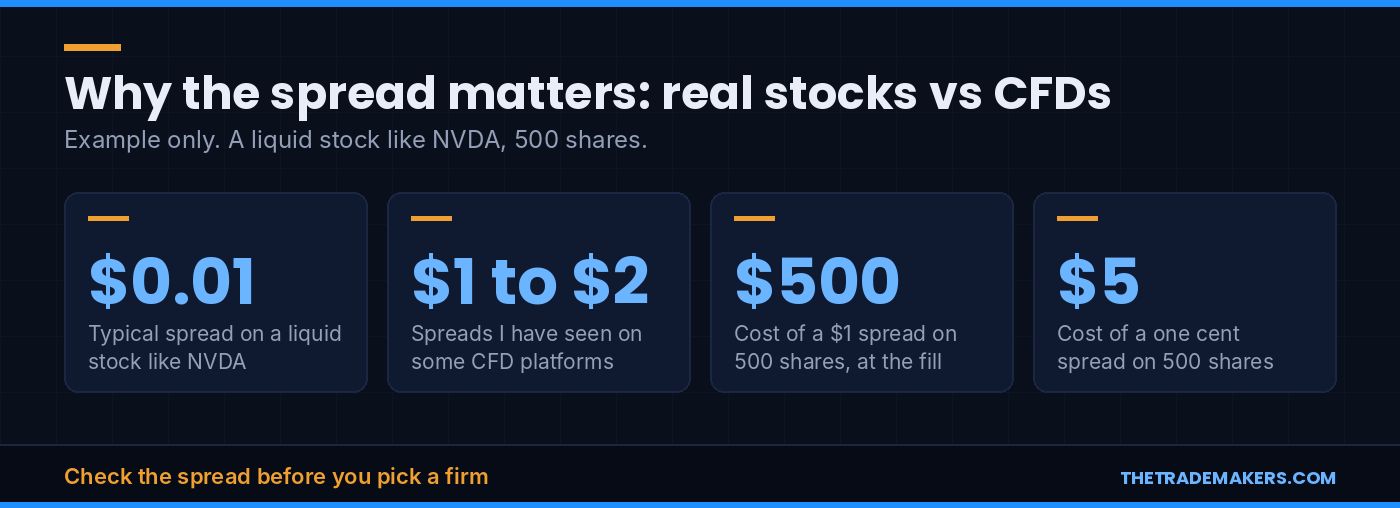
The difference I watch most is the spread. On listed US stocks priced from live data, a liquid name like NVDA usually trades a penny or two wide. On some CFD platforms I have seen a stock like that quoted $1 to $2 wide, because the provider sets its own price. Example only. Buy 500 shares into a $1 spread and you are down about $500 the moment you are filled, before the stock moves at all. Live data that matches the market is the closest a simulated account gets to real trading conditions.
Prop firms for stocks compared
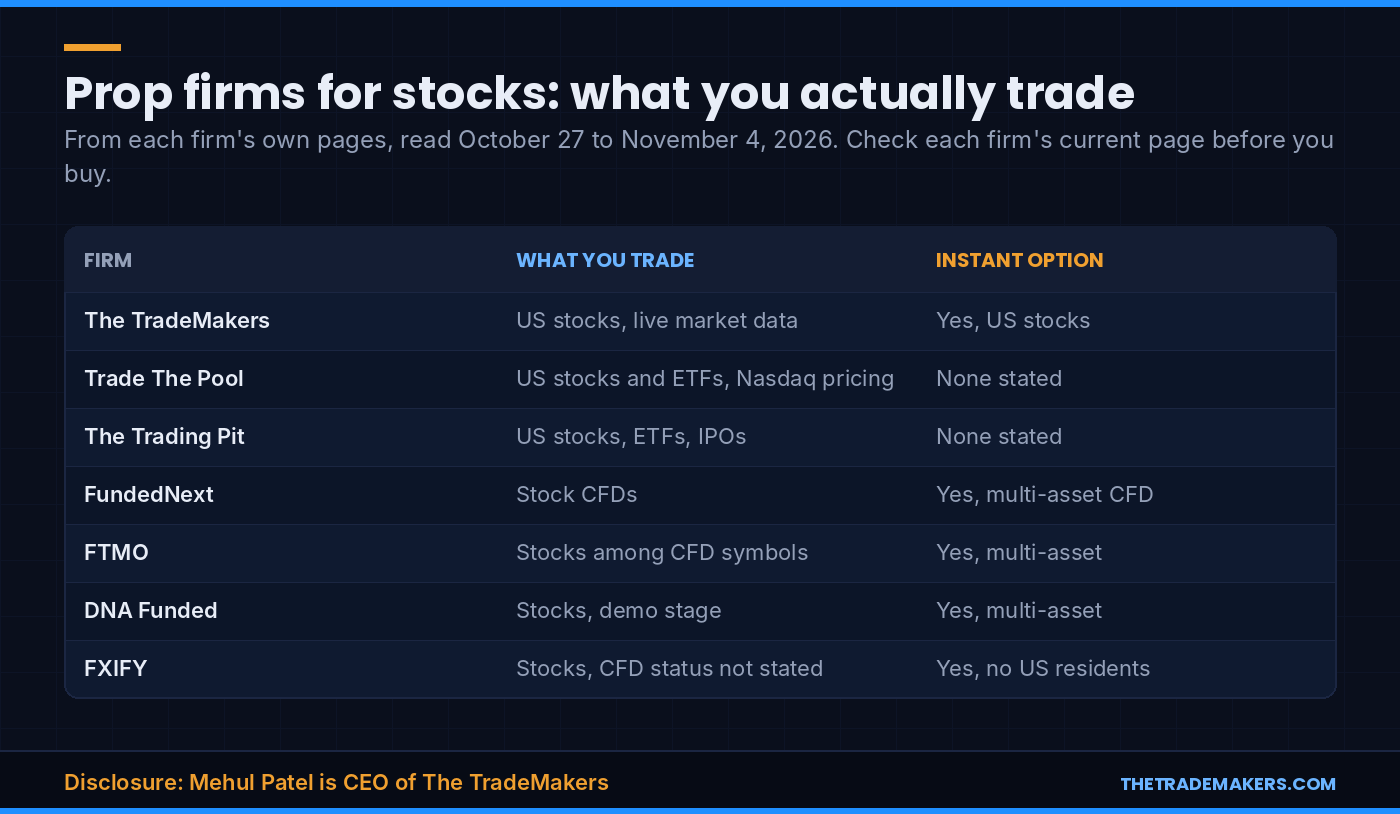
Here is what each firm's own pages say about its stock offering. None of these are brokerage accounts; read each firm's own wording on how its accounts work.
The TradeMakers (our firm)
- What you trade: simulated trading on listed US stocks, priced from live market data, on the BlackArrow platform.
- Models: Instant Equities, no evaluation, six tiers from a $10,000 simulated account to a $350,000 simulated account. Challenge Equities, a monthly evaluation with $25,000, $50,000 and $100,000 simulated accounts.
- Drawdown: static on Instant Equities. Intraday trailing in the Challenge Equities evaluation, then end-of-day trailing in the simulated funded stage. Details on our Drawdown Types page.
- Trading day: on Instant Equities, positions must be reduced or fully closed by 3:58 PM ET, and earnings holds are not allowed. Challenge Equities accounts cannot hold overnight.
- Fees: one-time fee on Instant Equities plus a per-share execution fee; monthly evaluation fee on Challenge Equities, plus a one-time activation fee after you pass.
- Both at once: one trader can hold Instant Equities and Challenge Equities accounts at the same time.
- US traders: our terms do not exclude the US; they exclude sanctioned or prohibited jurisdictions.
No overnight holds on Challenge Equities is on purpose. Holding a stock into earnings or a press conference and hoping is a terrible way to build habits. We are not trying to be a betting app. We want traders building good habits.
Trade The Pool
- What you trade: US stocks and ETFs in a simulated environment, using third-party data that reflects Nasdaq pricing, per its program terms.
- Model: a one-step evaluation in several program types. No instant option stated.
- Trading day: day accounts are closed out 10 minutes before the end of regular trading hours.
- Platform: a customized TraderEvolution.
The Trading Pit (stocks product)
- What you trade: US stocks, ETFs and IPOs. Its site states all accounts are demo accounts with virtual funds. Details on its stocks page.
- Model: a challenge, then a funded stage. $25,000 and $50,000 accounts. No instant option stated.
- Drawdown: 4%, trailing the end-of-day balance until it reaches the starting balance, then fixed.
- Trading day: no overnight positions.
FundedNext
- What you trade: stock CFDs inside its multi-asset accounts. Its own stocks article says you do not own the underlying shares.
- Models: evaluations and an instant account, with stocks available across its models.
- US traders: US clients access its CFD accounts through Match-Trader only, per the same article.
FTMO
- What you trade: stocks appear among its CFD symbols. FTMO states its accounts use fictitious funds in a simulated environment.
- Models: a 2-Step, a 1-Step and an Instant account.
- Drawdown: static on the 2-Step, end-of-day trailing on the 1-Step, and a balance-based trailing limit on the Instant account, per its trading objectives.
DNA Funded
- What you trade: stocks are tradable in its accounts. Its FAQ describes a demo stage.
- Models: 1 Phase, 2 Phase, Rapid and Instant Funding.
- Platform: TradeLocker.
FXIFY
- What you trade: stocks are offered alongside forex and other markets. Its pages do not say whether stocks are CFDs.
- US traders: FXIFY states it does not open accounts for residents of the United States. See fxify.com.
We also checked Maven, Funded Trading Plus, Lark Funding, The5ers and Eightcap Challenges. None listed single stocks on their own pages when we read them; The5ers points stock traders to Trade The Pool. We could not load the pages for Alkaline Funding or Funded Elite, so they are not included.
Instant funding for stocks: who offers it
Several firms sell instant accounts. FundedNext, FTMO and DNA Funded all have one. But on their own pages, those instant accounts are multi-asset accounts, not simulated accounts on listed US stocks priced from live data.
Of the firms we checked, The TradeMakers is the only one offering an instant account on listed US stocks. You buy a tier, pay once and trade the same day, under a static drawdown that never moves up with your profits.
Many of our traders run both. They trade a bigger instant account first, then move to a challenge account and keep building it once they are done for the day. Through 2026 we have seen the mix shift: more traders now choose instant accounts than evaluations.
The trade-off is real and we publish it. The payout rules on Instant Equities are stricter than on our challenge: a 20% consistency rule and qualifying days before a payout. I walk through every rule, the six tiers read as risk and the per-share fee in our guide to instant funding for stocks.
The PDT rule is gone: do you still need a stock prop firm?
For years the pattern day trader rule was the reason many small stock traders looked at prop firms. Under it, a margin account needed $25,000 to day trade freely.
That changed. FINRA replaced the pattern day trader rules with new intraday margin standards, effective June 4, 2026, per FINRA Regulatory Notice 26-10. There is no more pattern day trader designation and no $25,000 minimum. Brokers have until October 20, 2027 to phase the new standard in, so check what your own broker has done.
So no firm should sell you a stock prop account as a way around the PDT rule. Once your broker adopts the new standard, that reason is gone. The honest reasons left are different.
For me the biggest reason left is buying power. Put $2,000 in a margin account and the new standard requires you to hold at least 25% equity against your long stock positions all day, so at most you can carry about four times your equity during the day, roughly $8,000, and brokers can set it lower. That keeps you trading very small. For a one-time fee, an instant account like our Gold tier gives you a $100,000 simulated account with a $4,000 static max drawdown, which is more room to size a liquid stock properly. What you can lose is what you pay: the account fee plus the per-share execution fees. Size to that $4,000, not to the $100,000 simulated balance. If you want experience first, an evaluation costs less up front, so you build it without putting much at risk.
The small account has a second problem. $8,000 of buying power pulls people toward small caps, penny stocks and same-day options, and those are boom and bust. I would rather trade liquid, high-beta stocks with a big average true range, or liquid futures like ES and NQ. That is where you can size properly and still control risk.
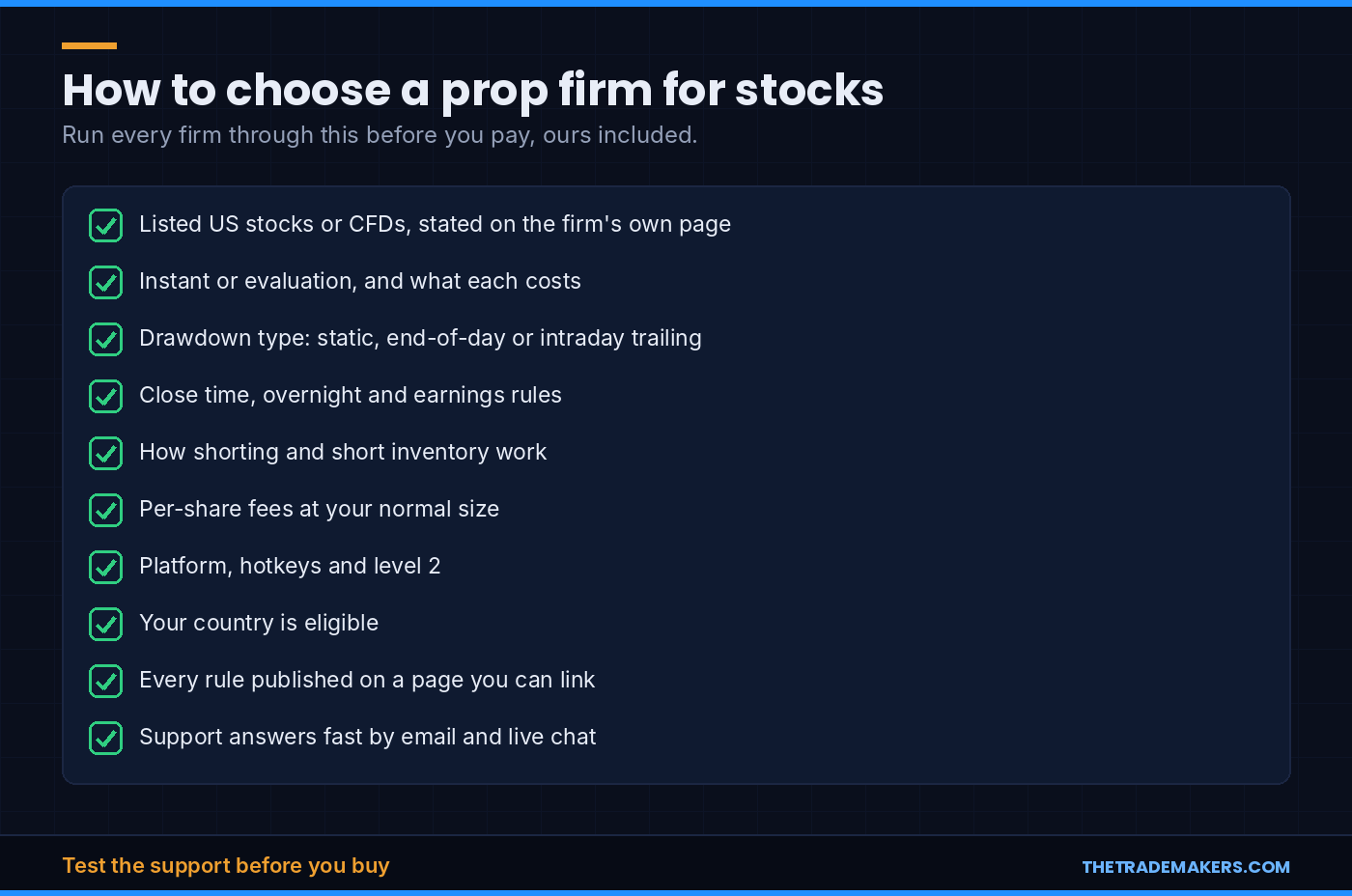
How to choose a prop firm for stocks: a checklist
Run every firm, ours included, through these before you pay:
- Listed stocks or CFDs? Find the sentence on the firm's own page that says which. If you cannot find it, ask in writing.
- Instant or evaluation? An evaluation costs less up front and adds a profit target and a clock. An instant account skips both and usually costs more. Our Choose Your Account page compares ours side by side.
- Which drawdown? Static, end-of-day trailing or intraday trailing changes how you can hold a winner. Some intraday trailing drawdowns count open profit, so ask how yours works.
- Overnight and earnings rules. Most stock prop accounts are day-trading accounts. Know the exact close time and the earnings rule before your first trade.
- Shorting. Ask how short inventory works.
- Per-share costs. Fees per share add up fast if you trade size or scalp.
- Platform. Make sure it runs on your machine and has the hotkeys and level 2 you need.
- Can you trade from your country? Some firms do not accept US residents.
- Is every rule published? Drawdown, payouts and consistency should be on a page you can link to, not in a chat reply.
- Test the support first. Email a real question before you buy and time the reply. Check for live chat. You will need support the day a platform freezes or a fill looks wrong.
Who should not use a stock prop firm
Two kinds of people should not buy a prop account at all. First, anyone who does not have money they can afford to lose. The fee is real money, and you should expect that you could lose it. Second, anyone with no trading education yet. A prop account is a bad place to start learning. If you are jamming buttons on day one without knowing trends, patterns or basic technical analysis, six months later you will have lost money and built six months of bad habits, and breaking habits is much harder than building good ones. Build the foundation first. That is one of the most important things you can do.
If you fit a stock prop account, our equities tiers are in the pricing section. For the bigger choice between an instant account and an evaluation across stocks and futures, read our instant funding vs evaluation guide.
About the Author
Mehul Patel is the CEO of The TradeMakers and a futures trader. He holds a dual degree in aerospace and mechanical engineering and worked at Goldman Sachs in operations and program management, where he built a forex prediction program from historical market data. He trades index futures and has passed evaluations at several futures prop firms, adding up to more than $4.5 million in simulated funded accounts. He is also a co-founder of Prodisphere, a sports technology company. Every rule for TradeMakers futures and equities accounts is published in the TradeMakers Knowledge Base.
Connect with Mehul: LinkedIn | X | Instagram
Frequently asked questions
Do prop firms let you trade stocks?
Some do. Most offer stocks as CFDs inside forex-style accounts. A few, including The TradeMakers, Trade The Pool and The Trading Pit, run simulated accounts on listed US stocks.
Which prop firms use listed US stocks instead of CFDs?
Of the firms we checked between October 27 and November 4, 2026, The TradeMakers, Trade The Pool and The Trading Pit state they offer US stocks rather than CFDs. Every one of those accounts is simulated.
What is the difference between listed stocks and stock CFDs at a prop firm?
A stock CFD is a contract that tracks a share price; the provider sets the price, hours and symbol list. A simulated account priced from live market data shows the real bid, ask and prints, so your chart, levels and spread match the stock you are watching.
Is there a prop firm with instant funding for stocks?
Yes. The TradeMakers offers Instant Equities: simulated accounts on listed US stocks, no evaluation, a static drawdown. Other instant accounts we found are multi-asset accounts.
Do stock prop firms use real money?
Not at The TradeMakers: every account is simulated and you do not trade the firm's money. Read each other firm's own wording before you buy.
Can US traders use a stock prop firm?
It depends on the firm. FXIFY states it does not accept US residents, and FundedNext routes US clients to Match-Trader only. The TradeMakers terms do not exclude the US. Check each firm's eligibility page before you buy.
Can you hold stocks overnight at a prop firm?
Most stock prop accounts are day-trading accounts. On TradeMakers Instant Equities, positions must be reduced or fully closed by 3:58 PM ET, and Challenge Equities accounts cannot hold overnight. Trade The Pool closes day accounts 10 minutes before the end of regular hours, and The Trading Pit allows no overnight positions.
Can you short stocks at a prop firm?
Usually yes on liquid names, but on listed stocks short inventory is limited, so a stock you can buy may not be available to short.
Do I still need a prop firm now that the PDT rule is gone?
Not to get around the PDT rule. FINRA replaced it with intraday margin standards effective June 4, 2026, with brokers phasing it in until October 20, 2027. The main reason left is buying power: a small margin account can carry only about four times its equity during the day.
What drawdown do stock prop accounts use?
It varies. TradeMakers Instant Equities uses a static drawdown; Challenge Equities uses intraday trailing in the evaluation and end-of-day trailing in the simulated funded stage. The Trading Pit trails the end-of-day balance until it reaches the starting balance.
Can you hold an instant account and a challenge account at the same time?
At The TradeMakers, yes. One trader can hold Instant Equities and Challenge Equities accounts at the same time.
Which platform do stock prop firms use?
Each firm picks its own. The TradeMakers uses BlackArrow, Trade The Pool a customized TraderEvolution, DNA Funded TradeLocker, and CFD firms often use MetaTrader, cTrader or similar.